
Han Kang is my favorite Korean author whose works have the capacity to capture your heart, brain and gut and trap them in a story vice along with a character conflicted with an existential crisis. In this issue of Bookisshh we’ll explore, Greek Lessons authored by Han Kang and translated by Deborah Smith (who has translated everything I’ve read by Kang to date) and see where they take us and how we fare. Enjoy!
Before we dive in deep, it’s important to pause and consider devoting quality reading time to translated works which are not widely celebrated in the United States. Reading translated works exposes readers to alternative stories, historical aftershocks and cultural responses from across the ocean. Translated works and translators synthesize and create wonderful narrative alchemies and make available to readers the lives, joys and tragedies of our international neighbors. Translators enable readers opportunities to witness and find common ground stories while discovering how politics, culture, language and economy differ, intersect and produce varied outcomes and some similar to stories of local origin.
Deborah Smith has translated Han Kang’s work for a long time and it’s important to note that by the time some works are translated and printed in English, a work may have preexisted 10 years earlier in its mother tongue. Translation, twice the effort at storytelling does a lot of things. Translators consider culture, time, language, politics, ethics, feeling , essence, ways and mores when plotting and creating dialogue and building metaphors. Within a work a translator decides what is literal and then looks to build context and subtext as well as other elements of literature. Translation hinges upon the unique relationship between translator and author which can include literary and historic shared appreciations, creations and substitutions of metaphors, analogies or explanations when language and or logic evades the narrative. It’s tough business and the translator often remains invisible and unappreciated. A fun experiment—find an author you like and read 1-2 works by them and the same translator. Then try to find one by the same author and a DIFFERENT translator and see how things feel different for you. For now, dear Bookisshh friend stay with me, Han Kang and Deborah Smith and see how Greek Lesson fares in this Bookissshh universe. Enjoy!
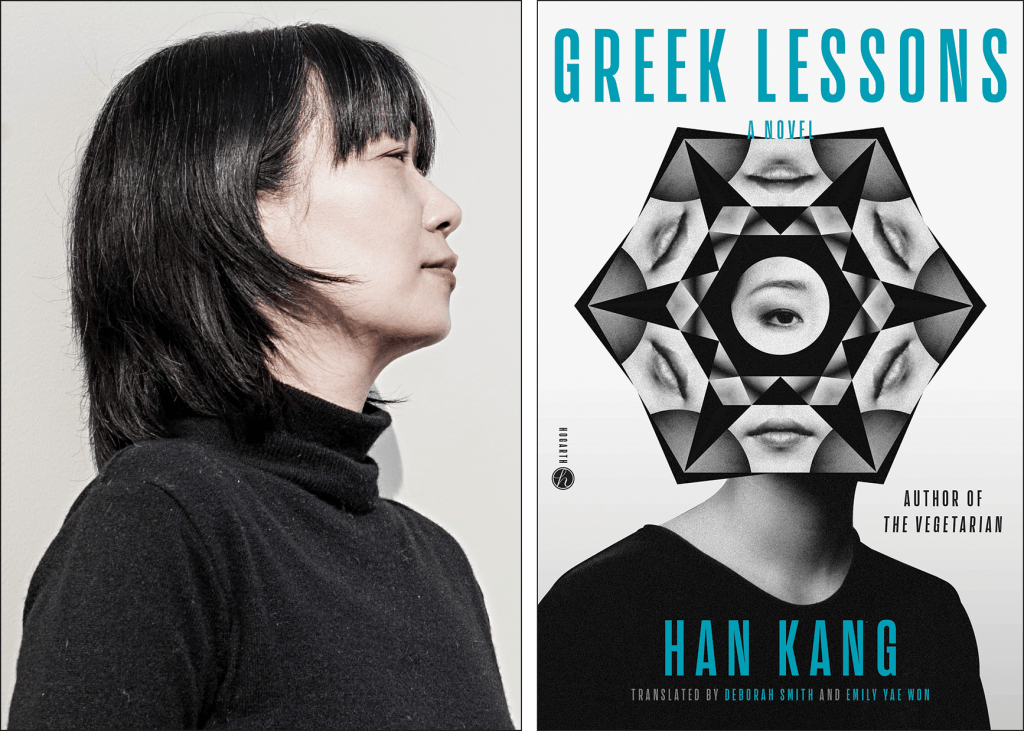
Kang’s writing offers readers rich, visceral sensory experiences and stunning/startling imagery. Kang is not an author you read before bedtime unless you want to remain in deep, overstimulating contemplation until sunrise (it has happened). Kang immerses her readers into the painful, off-putting experiences of her characters as they endure pain and ecstasy and juggle archaic and modern traditions while choosing alternative life paths and ignoring untapped vulnerabilities as they journeythrough their lives. Her books are thin in terms of page count but nothing else.
In Greek Lessons Kang interrogates how language and memory are impacted as human bodies decline in varied neurological capacity. Further, Kang exacerbates the effects of physical decline when she imposes cultural displacement onto the lives of those struggling to see and hear. At this juncture, Kang finds a “love story” between two people with limited sensory intersection onto which they must build base instincts like love and trust as they endeavor to endure time. She asks readers to consider what people draw upon as they reckon with interpretation and submit to both emotional and physical vulnerability when memory too is in decline because sensory input fails to inform. If that is not enough, Kang layers in Greek philosophy, linguistic theory, and fragmented stories of displacement making readers wonder, what really matters within the condition of love?
The premise is entirely unique: A Korean woman emigrates to Germany during her early youth. This girl struggles with her developing self concept due to cultural intersection tensions. Coping with physiological speech challenges, she grows confused and loses her capacity to speak and participate within her surroundings. Later she returns home to Korea and meets a Greek language instructor at the prestigious academy at which she studies. Little does she know that her Greek instructor struggles with impending blindness and somehow they fall in love despite the direct communication they are unable to share.
The meditations on language, meaning and memory and the impact on expression, experience, and time are context are gorgeous. While Kang’s citations of Greek Philosophers added depth and expansiveness, it also brought distraction to the readers. Within the narrative Kang inserts Platonic theories and for this reader these philosophical inserts created thought loops and spirals leading me to wander from the story and upon returning, I couldn’t remember who was narrating and what they were saying. If this was intended, the struggle was real.
As the lovers continue to lose their speech and vision, Kang builds a story in fragments bringing past and present together. Kang also has characters witness their memories and question them from the present vantage in the story. Kang does not allow memory to neatly add up to what characters are questioning or aiming to accomplish. It’s frustrating and leaves both characters and this reader with a strong awareness of pain.
Pain doesn’t require language and it certainly trumps pleasure, but it’s a necessary tool when building compassion and Kang does this so well. Pain cannot exist without pleasure and Kang provides her readers with pleasure filled rabbit holes to immerse oneself in joyfully. For instance, Kang’s descriptions of a rainstorm beginning with echoing drops to shushing curtains of showers, receding into winds that whistle and blow them onward away. Characters are encouraged to use what senses remain and find pleasure in those moments as their bodies inevitably decline and mortality inches toward them more closely. The author leaves her readers with questions regarding pleasure, pain, choosing which and why. She asks us to evaluate what is nonsensical and what is essential when considering quality of life? Kang offers immersing and bathing oneself in nature and it’s beauty, the complexities of language and language acquisition, sex and its drive in people’s lives, the innocence a lost animal experiences when it wanders unwelcome in a human domain.. Who are we to define pleasure and determine a pleasure universal? Life is short, sometimes sweet, so live. By immersing readers into her orchestrated chaos she forces that choice-making—kind of liberating.
Overall what’s missing for me in this work is clear structure though the impact it had on me cancels this complaint, however dear readers if structure and clarity are primary for you tread carefully through Greek Lessons. And if a clear, meet-cute type of love story is what you seek, further tread carefully. Finally, if you want an immersive and atmospheric work, then give Han Kang and Greek Lessons your attention for a short moment and see how you come out the other side
.
 Bookisshh