
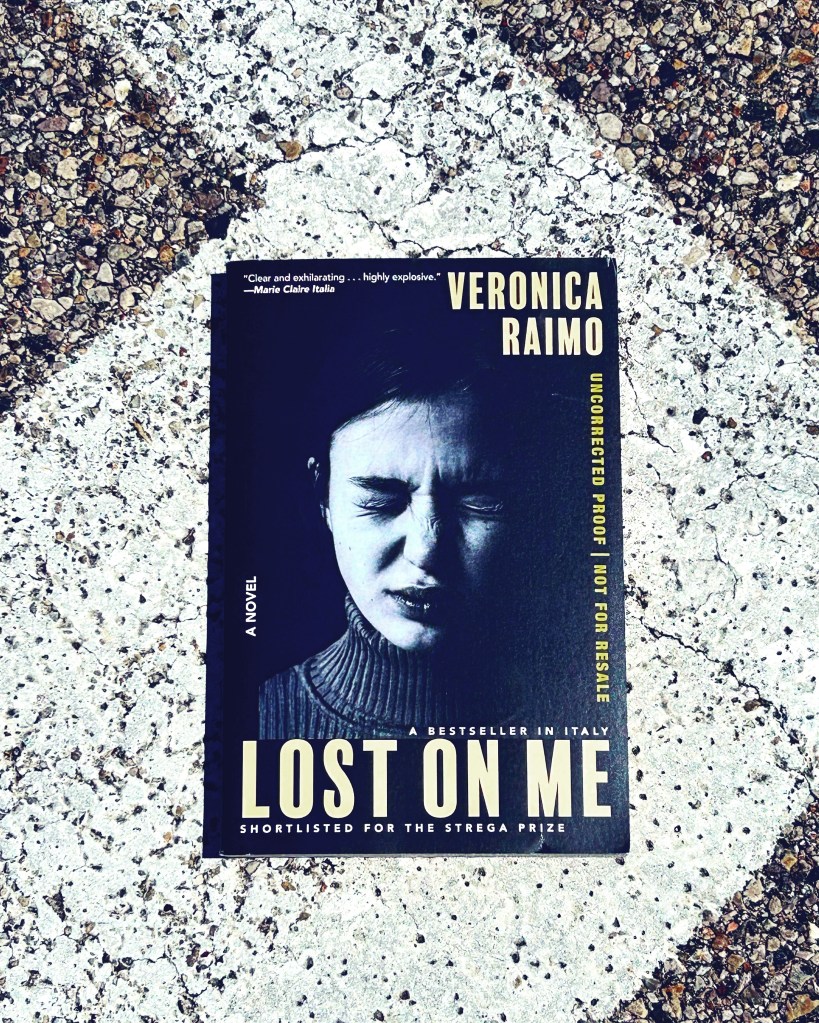
It’s been a wonderful discovery exploring the Black Cat imprint of Grove Atlantic publisher. Grove Atlantic is an independent publisher NOT owned by Penguin Random House or the recent Private Investment firm KKR that purchased Simon and Schuster much to both Penguin and Congress’ chagrin. Private investment firm? Indeed…
Likely, dear reader, you might overlook the small gesture which involves noting the imprint (which is like a brand label for a publishing division) of the books that are un-put-down-able. I challenge you to look at the imprint if you are bored with your book club selections or find yourself struggling to remain committed to that book gathering dust nearby.
This book, Lost On Me by Veronica Raimo is a gifted copy to me by Grove Atlantic, under the Black Cat imprint. Lost On Me was originally published in Italy in 2022 and later translated to several languages including English and was picked up by Grove Atlantic and published in paperback in July 2023. I have never read anything like Lost On Me. But first a little bit about the author…
Veronica Raimo, born 1978 in Rome, is an Italian writer, translator, screenwriter, and holds a degree in Literature and wrote her thesis on German cinema. During her post-grad years Raimo lived in Berlin and worked as researcher at Humboldt University. Raimo has written serveral novels, a short story collection and co-wrote the film, “Bella Addormentata” which translates as Sleeping Beauty (not a Disney version). Raimo has received multiple nominations included the Silver Ribbon for best screenplay and was on the shortlist for The Strega Prize. If that doesn’t impress you, Raimo has also written articles for Rolling Stone, La Republica XL and other publications for those of us who deep dive into high brow pop culture.
This book: Lost On Me is a mash-up of genres—fiction and autobiography—also referred to as auto fiction. This mash-up allows writers to break, bend and add new rules to their writing. Things like this include: actual recounting of actual people, places or events. Additionally, an author may change points of view around, modify details, characters, scenarios, and plot with real-life characters in a search for the self.
The auto fiction mash-up further allows Raimo to employ, “Bildungsroman” within the genre to give it gravity and depth. As in auto-fiction, Bildungsroman facilitates the psychological and moral growth of a protagonist from childhood to adulthood in search for life’s answers. In literary fiction this is referred to as a “Coming of Age” story.
So what’s it about? Lost On Me is narrated through the point of view belonging to Veronika aka Vero, Smilzi, Corinna, Oca, Scarafona, V, Vera, Svekha, Onica, Nicca, Nip Little Nipple, Rag, Bimbo, Ms. Fringe Hussy, which depends on what stage of life she’s in and who Veronika is interacting with. The point of view is informed by Veronika’s self-discovery of family neuroses as she individuates from childhood to adulthood. Readers witness Veronika’s choice-making consequences and rewards all within the culture and time within which she grew up. I’m not going hold the curtain closed, so do note that there are some uncomfortable scenes in this book, and what makes them more uncomfortable is that author Raimo finds a way to inject humor into certain situations. So, if you are a sensitive reader be wary, take care and DNF (do not finish) if you’re too uncomfortable.
This book is an individuation story about a woman who struggles to be herself when connected to her family and how she faces challenges as she strays farther and farther away from home. Veronika’s household is eccentric, narcissistic, and neurotic. The father is a germ phobic and a hyper compartmentalized workaholic. He bathes Veronika in alcohol soaked paper towels to combat any sign of illness and/or injury. Her mother withholds critical information regarding her body in terms of developmental changes and how to keep oneself safe when venturing out into physical and emotional relationships. Veronika’s mother has addictions to religious penance and spends her time performing religious driven compensation and/or prayer for her errors. No one in the adult space is there for Veronika or her brother and the family complexes develop further complexes as the father literally builds walls to create tiny oppressive spaces in their tiny Italian apartment, which is entirely oppressive that humor really is required to reach the end of some of these pages.
The closet comparison to a safe haven is provided by Veronika’s brother who unfortunately is her competitor as well. Their grandparents offer some sanctuary but the costs outweigh the benefits. Their grandmother is loving yet invasive often humiliating, and while her grandfather gives her space to breathe he errs on perverse photographing her or helping her with constipation. Family and personal boundaries are labyrinthian to navigate in this auto-fiction.
It would not surprise the reader that during her lifetime Veronika struggles with dating, relationships and friendship so writing becomes her outlet and profession. Finding herself within her profession brings challenges as well because pouring one’s most intimate thoughts and truths onto a page provoke one to look away or embellish and Raimo does both. It’s challenging how she treats losses and violations with pain and acceptance. But she has no other choice because this is her life after all and she might as well mine it for entertainment because none of it is examined to improve or sustain relationships. Veronika wants to understand herself unapologetically for herself with possibly a benefit to no one including herself.
When I came out the other side of this book after snaking my way through the compartments of time and secret emotional spaces, my immediate thought was: It may be auto-fiction but it feels honest. Typical of translated works not a happy or tragic ending, but a charge to carry on with the business of living—good, bad, sad, ugly—any or all of it. Read it and weep, read it and be angry, read it and laugh. Just read it.
 Bookisshh