
Mash-ups electrify my brain and mostly because they promote intersectional thinking. Intersectional content possibly includes debates and/or conversations between change-makers and brokers of change. Intersectional discourse might look like an activist or artist speaking with a journalist as they discuss a topic or issue. Intersectional content might mash up food, science, art, economy, identity, gender, family, culture , etc. and discussions, topics, and issues become fastly politicized.
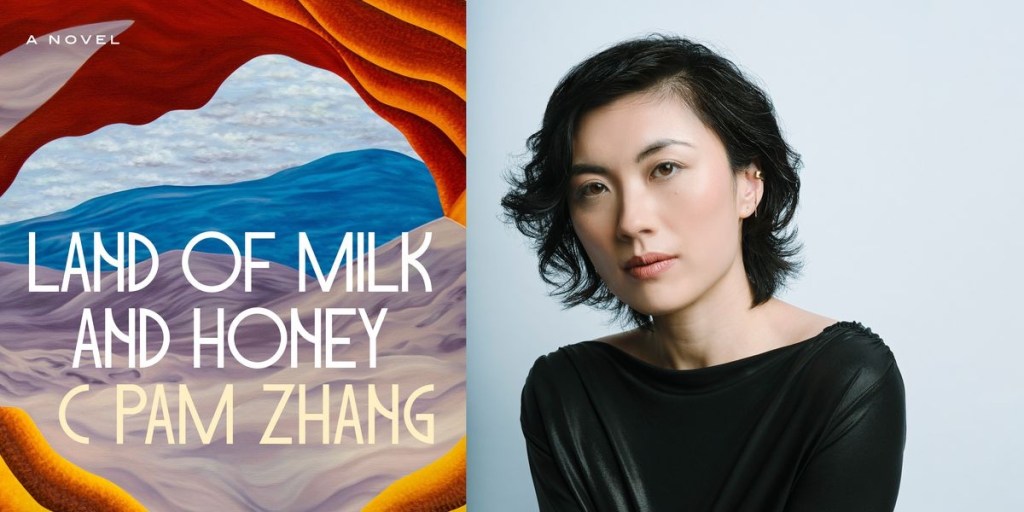
In this issue of Bookisshh, we’ll explore a work by author, C Pam Zhang, wherein Zhang intersects dystopia, climate collapse, cultural displacement, parental loss, identity, queerness, gastronomy, biomedical engineering, ethics, politics, elitism, autocracy, totalitarianism, and love. It’s a tall order and this book dips into all of these pots and remains remarkably short in page count.
When discussion/argument reaches the height of paradox, a reader might think: Stop the world I want to get off!! To mitigate when too much becomes too much, I enact a hypothetical panic button which facilitates an automatic stop to the content I’m engaged in. This pause enables me to create cognitive and emotional space and restructure my thinking for as long as I need to do so. It’s rare, but there are times when I hit the button again and the book becomes reclassified as a DNF (Do Not Finish).
THE PLOT: a corporate agricultural experiment conducted in Iowa has gone awry and has caused a dense smog to develop and cover the United States. This smog diminishes the food supply and has caused massive famine and death toll. Employing a first person narrator, Zhang moves from the United States and chef cannot return for personal and political reasons. The borders to the United States are closed. Wanting to leave dreary London, Chef falsifies her résumé in order to snare a job to work as a personal chef for a billionaire who lives on a mountain top in the Italian Alps. The mountain setting is highly deceptive.. Within the mountain’s bowels are hidden labs where biomedical engineering experiments take place. Every Sunday, the benefactor of this community invites tenant/guest/investors into his home for a deceptive Sunday dinner serving up ulterior motives.. Sunday dinners border on grotesque and are loaded with socio-political tensions between guests and “family”. Each dinner, more grotesque and performative than the one prior determines the chef’s fate, will she/won’t she, obtain a long term contract?
Land of Milk and Honey is gorgeous at the sentence level. At times I thought I was reading a tasting menu with wine parings. Zhang brings forward how food as a construct, and how a person might self-identify as being a foodie, is not an equal opportunity. Knowledge and experience of food when displayed in a social context demonstrate a person’s knowledge and worldliness. Or does it? Zhang turns up the fire when she makes epicurean dishes that are horrific and disgusting and diners who gorge upon them, become intentionally poisoned, purge uncontrollably and depart grateful for the invitation. The dining table becomes the tableau for the war between the privileged and the prize for the winners is sustained relevance in the future and a strange sense of holiness for their sins against humanity. It is hilarity or delirium you will have to decide…
The theme, loss of a mother quietly drifts in and out of the plot. Maternal loss is shared between chef and her employer’s daughter who becomes chef’s lover and collaborator. Neither woman has endured processing their grief. For this reader, there are a few open door bedroom scenes that I don’t prefer and it raises questions regarding the basis for their relationship. This content does not amount to much page content or plot development and characters seem sort of confused with one another—I think the book would have worked without it, but I respect Zhang’s right to write, so I read on and characters did as they do.
Zhang reminds us that as humans, during some years of our lives we are small, and dependent on elders for our survival. Later times we become large, central, adhere to beliefs that we are special and everyone should know. Zhang takes her humans to the level of becoming powerful and work tirelessly while dismissing ethics to demonstrate power to others by displaying wealth, exerting environmental and economic control or impact despite the fact that 90% of the world is falling outside their narrative. Playfully, Zhang smirks at this, pats readers on the head letting them know that all of this and none of this is true. She invites readers to live passionately, to decide, to grow and to risk stepping out of the matrix with faith that sustainability is possible within the unknown to all, whoever, from wherever they have come.
Dear readers, allow yourself to suspend expectations, to hold not one, two but many things in truth at one time. Take some breaks, take some walks, relish in silence and breathing. Try not to push a panic button because young as Zhang is, she invites us to consider that the earth was here long before us and will be after and our job is to live within the lifetime it allows us. Enjoy!
AN INTERESTING INTERVIEW BELOW ⬇️
https://www.eater.com/23889575/c-pam-zhang-land-of-milk-and-honey-interview
 Bookisshh