
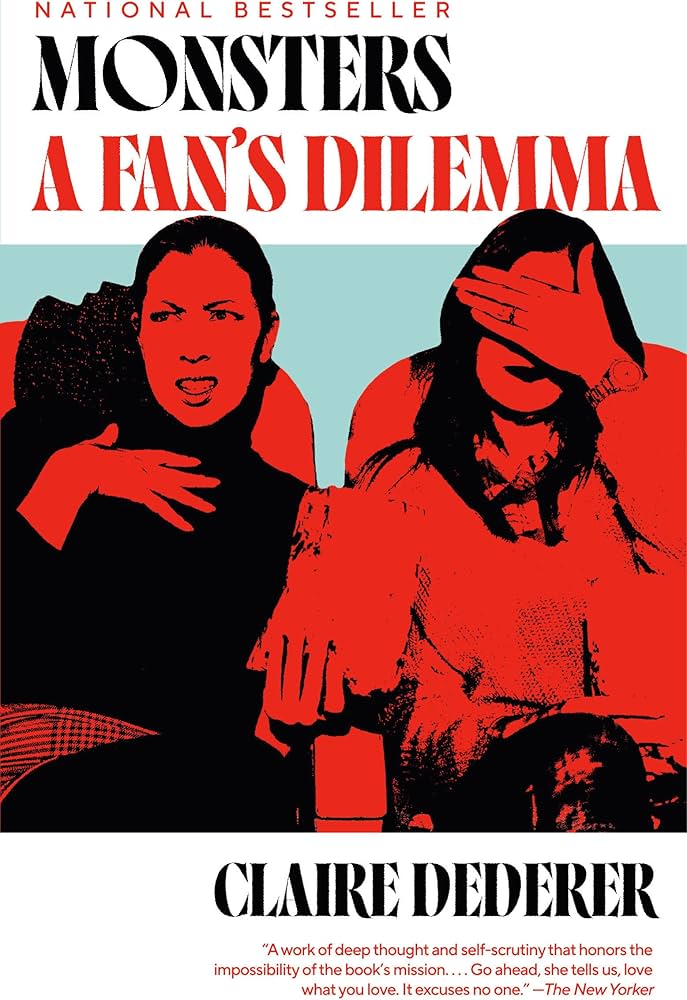
What’s your cancel policy when it comes to art and artists in any genre or medium? If an author, painter, playwright, musician, poet, director, photographer, cinematographer, actor, etc. behaves monstrously—assault sexual, physical, emotional or psychological—do you boycott, remove, ban their work? This can also trickle over to athletes, scientists, leaders, politicians and others who frequent the public eye or influence humanity’s existence. At this point, I will toss in tech bros, the manosphere, and further share that those who behave monstrously are disproportionately male. There’s plenty of monstrously behaving females who occupy the public view, and no matter who they are or what they’ve done, can you separate the artist from their art and enjoy the work? Or do you cancel them? What’s your policy? In this issue of Bookisshh we will look at author Claire Dederer’s, Monsters: A Fans Dilemma and see what she thinks and how she approaches cancel or not to cancel a monstrously behaving person of high esteem within the public eye.
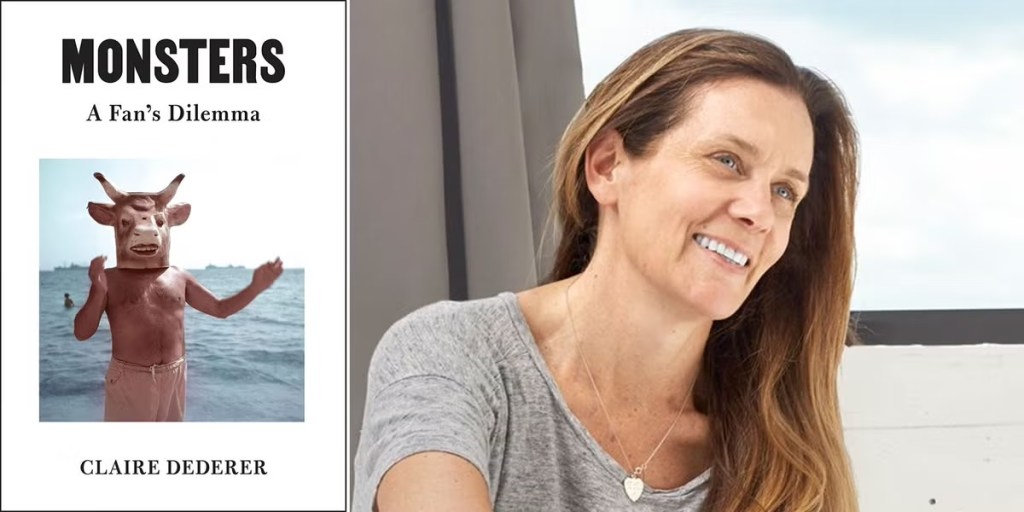
This is author Claire Dederer who lives on a houseboat in the Pacific Northwest. Dederer is currently married and has children with her spouse. She is a regular contributor to the New York Times and writes reviews, criticism and essays. The author also has 4 books published to date: Love and Trouble, Poser, My Life in Twenty Three Yoga Poses and Monsters. Dederer was also a film critic for the Seattle Weekly and taught Journalism at the University of Washington. The author has built an impressive career and yet I had never heard of her until this book from which I expected BIG things due to the critics and influencers I give consideration to when choosing books to read. I wasn’t blown away by this book, but I do place a premium on the argument that Dederer sets up: Can an artist be separated from a work of art when it comes to one’s enjoyment of said works?

How does Dederer structure this question? Does she reveal to readers what her cancel policy is? Does Dederer guide her readers through analysis and supposition with which a reader can confirm their own feelings and cancel policy? The answer is yes and no.
Let’s look at HOW the author structures this work which pairs consideration between the arts and morality. To begin, Dederer opens her discussion with a chapter entitled, “Roll Call” and the picture of the two men above— Roman Polanski and Woody Allen are called on the carpet.. I won’t repeat their crimes here but I will mention the works with which Dederer struggles with: Rosemary’s Baby, Manhattan and Annie Hall. I have consumed these film works during various stages of my youth. These films bugged me then and they bug me now. They bug Dederer because she continues to desire consuming, referencing and enjoying these works, hence struggling with cancellation for these purposes. Her book goes beyond calling out predators and looking at what she calls the audience biography who uphold these artists for a variety of unstated reasons. She claims that its the audience who create the artist by way of valuing their work for personal and varied reasons. Yet a cancel culture challenges these artists and artworks and attempts to remove them from the public view and discourse. Dederer struggles with being separate from the audience biography (or psycho emotional profile if you will) and struggles with her moral compass and artistic influencers. I found the tangents that the author went off on taxing, pedantic, neurotic and kind of incomplete. Nonetheless, I found it interesting most of the time, and I kind of felt bad for her…

Looking further into this book, Dederer introduces the concept of how an artistic work or person becomes stained by monstrous behavior that violates a person’s body, mind and/or spirit. The Stain is what is left on a work or reputation after the secret horror of what someone has done to another is out and one cannot hear a song, watch a movie, read a book, look at an image, listen to a speech without being distracted by their monstrous behavior. The author’s opening example points to the music of Michael Jackson who you can deep dive off this blog to discover his monstrous acts…
When confronted with a stain, dis-enjoyment and disturbance takes place in the audience member, art or theater goer and the work no longer delivers and audience retreats and turns away. Unless they are so devoted to some aspect of aesthetics the monstrous person can be overlooked or perhaps forgiven, Time and context or alternative facts are elixirs for the monstrous, and Dederer says cheers as she continues in her book to reconcile her not wanting to cancel her faves but maybe can temporarily deprioritize her monstrous creators for a spell. Apropos of this moment? Yes especially when the USA is 5 days post the election and the narrative shifts are moving at light speed and leadership is shifting and citizens are grasping at survivalist thinking, fear of betrayal. People want to cancel, can’t cancel and there are degrees of coping and confusion within the public sphere. I don’t have answers for you dear reader and author Claire Dederer doesn’t either. At this juncture, I ask you: Do you have a cancel policy or are you now experimenting with one?
Going forward a few chapters, Dederer’s book moves into discussions of Genius, Mass Media and Social Media’s Evolution, Fan Culture, Antisemitism, Racism and The Problem of Time. Taken together these chapters stretch and twist the struggle of how monsters evolve in their badness and exemplifies works generated by bad actors, the people and ways that the monstrous harm, and how certain people speak of the monstrous person’s brilliance anyway. Time can heal all wounds but not when there is collective memory or primary source evidence or people who are victimized in ways that the artist or famous person has harmed others. So cancel or not to cancel? Is there a universal answer to this question and Dederer’s answer is it depends on the individual or audience.
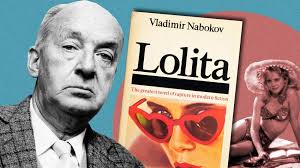
My favorite chapter is on Anti-Monsters when Dederer discusses Vladimir Nabokov’s Lolita. Dederer demonstrates how the artist Nabokov isn’t the monster but his character and unreliable narrator in Lolita is the monster. Illustrating this to readers Dederer show how a writer/artist separates from the art. There’s no nasty cancel proclivitie poop on Nabokov and his record. However Dederer shares how Nabokov points directly at how sickly monstrous men behave and does not separate them from their sickness or accountability for their actions in his book Lolita.
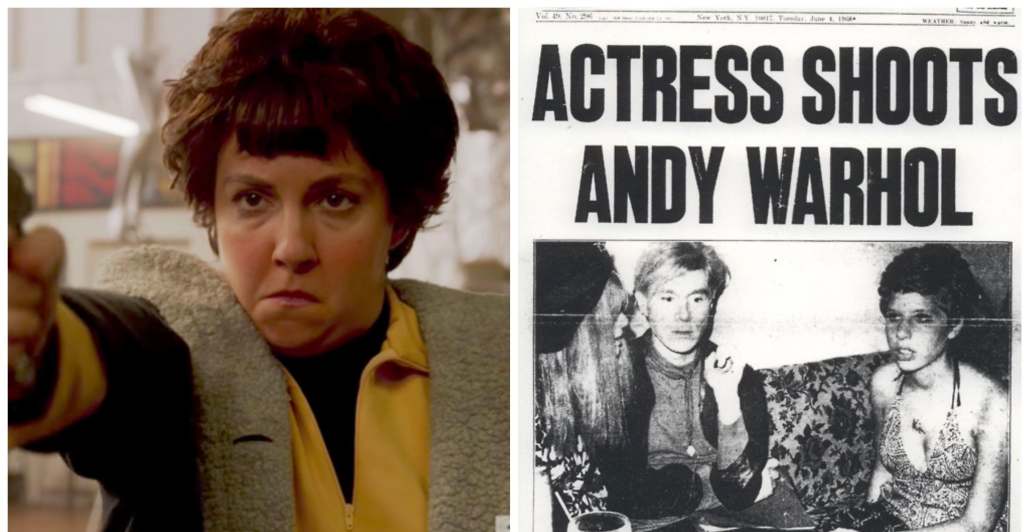
After this which is about the remainder 20-25% of the book, Dederer looks at herself asking: Am I a monster? Then she offers brief chapters on authors who choose themselves over family, children, convention and domesticity. She takes it far by bringing forward Valerie Solanas (murderer of Andy Warhol) and Sylvia Plath (murderer of herself). The author considers mental health when examining monstrous women, she delivers compassion on their behalf and a lens through which one can view their works AND she separates herself from them by claiming alcoholism, sobriety and accepting the limitations counterpart to loving and living fully within family life.
The chapter that examines female monsters is confusing and unfair to women.. I believe that feminism should protect and preserve a woman’s right to live her life any way she wants: be she a mother of 5, a Nobel Prize winning spinster, or whatever. She is kinder to women perhaps because she is one and struggles with her definition and practice as a writer.
Dederer’s position leans toward NOT cancel, but let time pass and memory fade and let the work stand and the audience to decide who is canceled or not. She cites those who express perhaps if/when one is revisiting a work they’ll be ok and if not HOPEFULLY another artist, writer, thinker, leader, scientist, etc. will take from great works of art and make something wholly and respectfully lasting. As I said, this book meanders and tangents. It’s chaotic, neurotic but so is the quandary in giving up something you enjoy. My bottom line is, “Live and let live, and DO NOT BEHAVE MONSTROUSLY.” The better question is: At this point do you know your cancellation policy? If not give Monsters by Claire Dederer a read. I recommend this book as is a backlisted purchase for Non-Fiction November. Enjoy!
 Bookisshh