
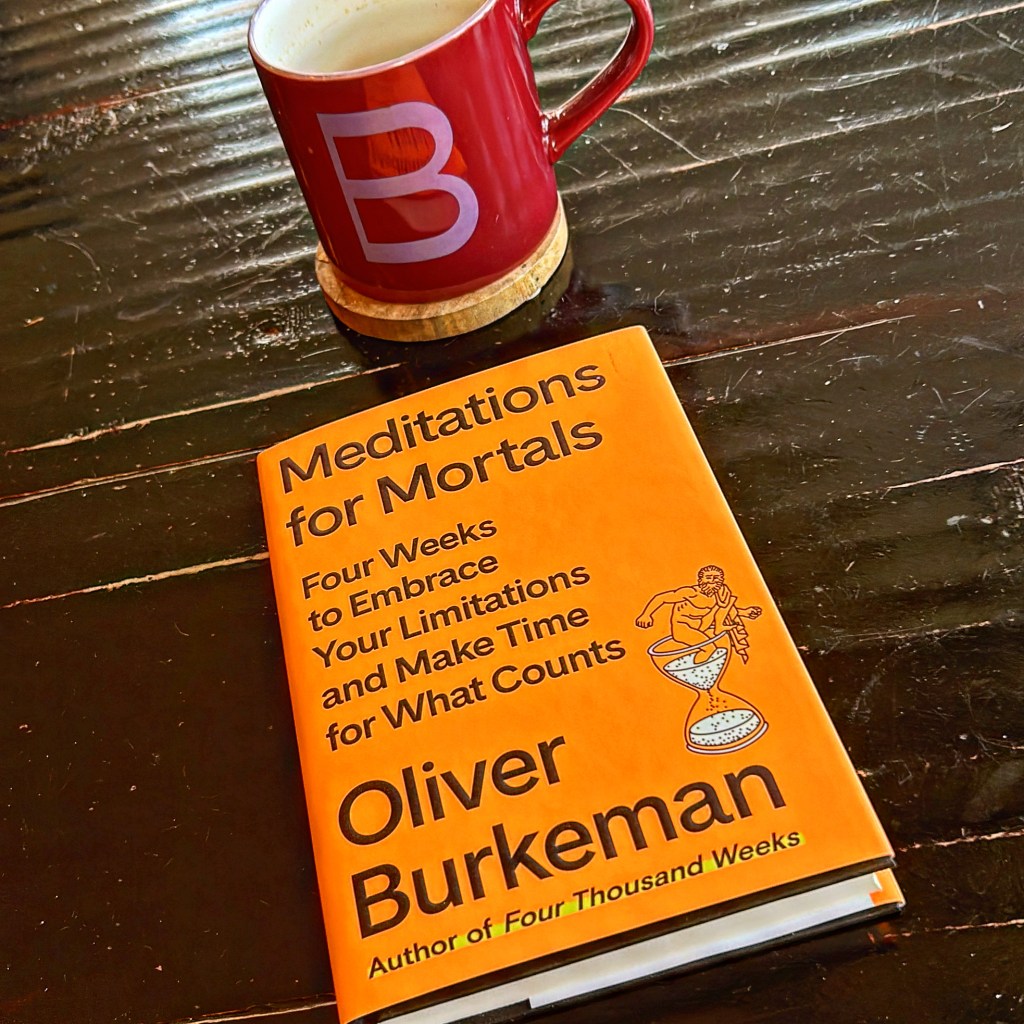
One day you wake up and you find that you can’t walk or use your hands effectively. Your life has changed without explanation and you realize that you have to live somewhat differently. You start to look for tools to cope with this changing scenario. At first, you run into what ends up being the wrong tools. Maybe you try meditation, maybe you try therapy, maybe you try books? I’ll bet you can guess what I tried and I won’t list how many it took me to find this one that came at the right time and was recommended by a podcast. In this issue of Bookisshh I’ll talk about the thin little book above, Meditations for Mortals by Oliver Burkeman, and how this book has affected my life and outlook in a very positive way.
Listening to the Bookclub Review Podcast and specifically the host named Kate, listeners will discover kate’s retelling of a buddy reading activity that she’s doing with a colleague. Kate decides to take on Burkeman’s Meditations for Mortals and do it as a 28-day project. Kate posts a daily reading meditation on her Instagram feed. During the daily posts Kate reveals her interpretations of each meditation, as well as reconsiderations of how she perceives and/or approaches challenges within her life. Additionally, Kate shares actions that she takes or experiments that she conducts enabling her to do or perceive things differently. For Kate the outcomes in response to Burkeman‘s book are inspiring to say the least.

I am the kind of person who in most cases will give an author a second chance on a different book when I don’t like the first one of theirs that I have read. I tend not to DNF books much to my chagrin. Before I found the book featured today, I was reading 4000 Weeks by Oliver Burkeman which is one of the few books I threw out the window, figuratively speaking, of course. Everyone should have a window to throw things that are jamming up or adversely impacting their life… Basically, this book examines that when added up, we only live about 4000 weeks and how might you live your time differently knowing this and what tools and tactics you can employ while living 4000 weeks more meaningfully? I found the book too didactic and snippy in that sort of Ivy League, holier than thou, bossy way. So out the window it went.
Feeling like a person who was out of time given the unexplained physical disabilities I was experiencing. Something simple as reading, meditating, taking action, really seemed like the reset opportunity I was looking for. So I sourced the book, put it in my suitcase and took off to Mexico with my family. Every morning, I would begin my day on the terrace looking at the Sea of Cortez, with my cup of coffee or water and the bright sun and Meditations for Mortals by Oliver Burkeman.
What did I discover? It began with the concept of finitude. Simply stated, finitude refers to the limitation of our existence. It means that we are limited simply because we are human and our bodies have an expiration date, unique for each and every one of us. This resonated deeply with me when this book came to my life. However, Burkeman uses a variety of ingredients to calm the fear and anxiety that this understanding can trigger. He uses quiet humor, philosophical reason, personal anecdote, and no judgment in trying to encourage his readers to practice finitude and get on with the business of living. I went into business, the business of living. I read this book slowly, daily-ish, and allowed myself to marinate in the thinking that finitude and comfort with finitude creates.
Meditations for Mortals is structured into 4 weeks, 7 chapters per week, and 28 entirely brief chapters at that. I won’t tell you about every chapter, but I will mention a few that really helped me turn a corner. During week one, day seven, “Let the future be the future: On crossing bridges when you come to them.” This chapter takes a look at anxiety and all of the advance thinking, planning, and panicking one can do before even confronted with an actual problem or consequence from a recently made decision. So many times all of that bundle of thinking, panicking, planning, panicking doesn’t even lead to the bridge one might have to cross in order to solve a problem or reach a destination. The bridges simply aren’t there sometimes so why worry about them until we have to actually cross them? This chapter helped me a lot with this kind of thinking and decision-making fatigue. Sometimes you just make the decision, cross the bridge and it isn’t so bad after all.
During week two, day 12, “Rules that serve life: On doing things daily-ish.” This chapter gives one permission to do things with a sense of frequency, but not rigid scheduling. It helps one feel successful when they’re being successful and not a failure when they’re not doing that thing that brings them a pre-specified type of success, relief, joy because we simply can’t be doing those things all the time.
I love week three and a very helpful chapter for me was day 15, “What if this were easy? On the false allure of effort.” Here’s when I discover that unknowingly I tend to choose the hardest way of doing things without asking myself, “What if this were easy?” I can’t tell you the torture I put myself through not being able to do something a certain way that maybe even I thought was right or perfect and either gave up or exhausted myself to some sense of completion. I never stopped to ask myself what if this were easy or there was an easier way to do something? This just really rocked my world and I took a lot of pressure off of myself because of it. I also learned how to ask for help
Finally, during week 4 there are too many things that helped me at that juncture but one chapter that really gave me something was on day 24, “Scruffy hospitality: On finding connection in the flaws.” I’ve been really sick since June and feeling very lonely and isolated. I decided to start letting people come over and see me in this very moment that I’m in. I allowed myself not to put on the great show of being a hostess and just being enough for people to come over and spend time with and have whatever’s in the fridge or pantry. It was liberating.
I can’t say enough good things about this book. I’ll probably never lend it to anyone. I know I need to revisit the chapters that didn’t stand out to me at some point or another. But this little book helped me accept my limitations of the moment and as I’m heading towards treatment, I’m grateful that I discovered it from Kate.
I like to whisper the title into the ears of kind friends who are struggling with this or that. If you or anyone you care about is struggling with something in life perhaps their mortality perhaps a change or loss, point them to Meditations for Mortals by Oliver Burkeman. It’s gentle and manageable. The author offers a wonderful index of ailments that help people define what they might be going through at various points of reading this. He also cites a lot of Zen masters and other contemplative types of people who have published and impacted generations of people through time. What’s nice is it’s a little skinny book that can be done in 28 days or longer or shorter if one is so inclined. Should you read this or share it with a friend or loved one please do let me know.
 Bookisshh