
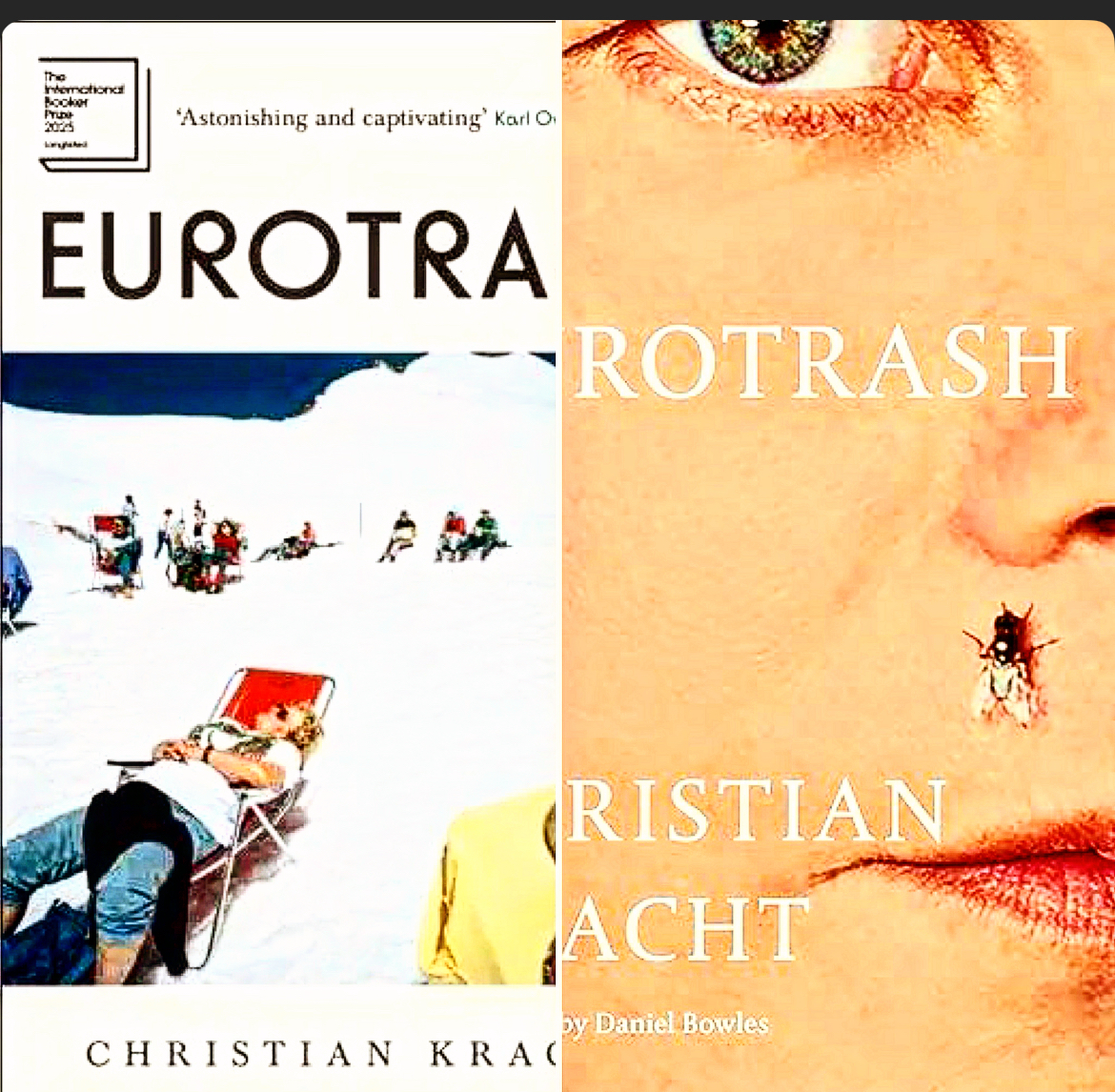
When I think of the word “Euro“ my first thought takes me the to the currency of the European Union that encompasses the national currencies of France, Germany, Spain, Italy, Greece, Portugal, Luxembourg, Austria, Finland, the Republic of Ireland, Belgium, and the Netherlands during 2002. When you put Euro together with the word Trash thus creating Euro trash you reference a term for certain Europeans, particularly those perceived to be socialite, stylish, affluent, and effete. Euro trash also suggests a collective term for European migrants in the United States or other areas with a concentration of wealthy Europeans. It is considered a derogatory term and some might see it as a humorous or ironic description of themselves or others. That is if you’re an insider or fellow euro trash member…
My favorite definition can be found in the Urban Dictionary:
Euro trash is a person, male or female, from continental Europe, who spends most of the time partying and jet sitting around the globe in the most conspicuous (sometimes rude manner) to see fun and sunshine. Eurotrash are often seeing sporting fashion from designer houses like Versace and dolce Gabbana with bold colors and animal prints. Too tan and always adorned with excesses of 18 karat gold jewelry, and sunglasses. Far from subtle and often newly rich. Eurotrash eat caviar and drink champagne like water just because they’re expensive while having no idea or appreciation whatsoever.
Really, Euro Trash is context driven and the lack of context and gratuitous subtext in this novel brings me to this very ripe discussion of Eurotrash by Christian Kracht. So hold onto your passports because in this issue of Bookisshh I’ll take out the trash from euro trash and see what’s left behind in this novel. Enjoy.
Eurotrash was brought to my attention by the International Booker award which awards books written in a host of international languages and translated into English. The author, Christian Kracht, is a Swiss author with German heritage and his book, Eurotrash, caught my attention because it was supposed to be hysterical and I really appreciate a good laugh. When I think about various comedians who have tried to make holocaust or holocaust-adjacent jokes, I recall mention of how hard it is for a comic to incite a laugh because it’s always too soon to poke fun at this historic genocide. I wondered what this book, Eurotrash, would do in a spirit of laughter given its content. Could this book possibly be funny let alone hysterical? I had to read and find out.
Not funny. In fact, this novel is pathetic. Narrated in first person by a flaneur Euro Trash son who maintains no primary residence and is reconnecting with his 80-year-old mother who is institutionalized due to dementia as well as other health concerns in Switzerland. The narrator’s parents are long divorced and his father is long since gone. Both narrator and mother live off great “family” wealth with origins in art and. real estate ripped from the hands of people murdered during the Holocaust. During the story’s past Third Reich members and sympathizers stole, traded and reshared treasures and accumulated wealth belonging to the people they persecuted and murdered. While rehashing the past author, Christian Kracht, employs a bored and nonchalant tone as he name-drops former Reich members and friends whose hands sold and passed stores of valuable belongings to one another and consumed for their own enjoyment. The narrator name drops Reich persons of interest and posh destination locations pointing the way to where the spoils of war remain and who might own them to this day. Meanwhile, the son is visiting and vacationing at some of these places or remembering those people fondly. Are you laughing yet?
Initially the story is set in Zürich which the unnamed narrator describes as, “A city of money-grabbing middle management, depressing hustlers and reserve lieutenants.” Meanwhile, the narrator’s octogenarian mother is addicted to pills and alcohol and is waiting to die. The narrator’s grandfather was a Nazi party member since 1928 and was later sent to a British internment camp to be deprogrammed. Deprogramming was unsuccessful. The Nazi grandfather was able to fake his way through the deprogramming process. Once released back into his life the Nazi grandfather behaved in ways perverse, misogynist, and engaged in seriously sexually bizarre behaviors. He also had a large network of wealthy people who behaved similarly. The narrator really shows quite casually how sick this group of people really was. Patriarchal party members often had secret sex rooms and the exploits that haunt these rooms are violent and hurtful to all women, children, and men. There are brief and fleeting descriptions that leave much to imagination. How about now? Is this funny? Hysterical?
And so the son picks up his mother who has a colostomy bag and requires assistance changing it. A teachable moment for her son for sure… For some unexplained reason, mother and son possess bags full of dirty money to ultimately give away to unsuspecting and unknowing people in some spirit of reparation for the crimes and atrocities committed by Nazi and Third Reich sympathizers as well. However no history of the money’s origin is shared with readers or potential recipients is shared. This is like casting pearls before swine and I’ve given up looking for comedy at this point in reading.
During one scene when mother and son take a hot air balloon ride and during this windy ride they offer the money to a group of women from India, who decline this peculiar generosity and the large sums of money blows away in the wind. Not funny. It’s not funny, forcing money upon people who might live within the margins during a precarious situation such as a windy balloon ride. The irony is so twisted it snaps.
Moving along on their journey, son and mother are supposed to visit Africa. From a bag of cash the mother and son give a bunch of money to a driver who takes them back and forth and ultimately nowhere. Not funny. Maybe it’s funny that no one wants the money? The people who hold the money don’t want the money. And the people unwilling to receive the money might need the money and don’t want the money. And the people who do little work to benefit humanity will happily take the money. However, you slice it not hysterical.
Maybe putting one over on a mentally unwell elderly woman is supposed to be funny? The narrator’s mother is old. Her short-term memory is shot. Her long-term memory is too far in the past and she wants to go to Africa and so they drive around taking the long way back to Switzerland. Her son learns how to change her colostomy bag and how to treat her with tenderness and tells his mother at the end of the trip he enjoyed going to Africa to see special flowers with his mother when they never really left Europe. The son and driver deposit his mother aka third reich heiress back to the sanatorium in Switzerland where she will wind down her body and life.
The son doesn’t have big feelings about any of it— he is inept at feeling and foundation building. He doesn’t examine himself and his sense of personal ethics. The son plans to continue pulling up his roots and traveling to new places and not doing much of anything in a spirit of contrition for his ancestral and dark heritage. The son will live a liberated version of the same thing that his mother lives out – – move around, hide from the truth both monetary, psycho emotional and historical. So you see this tragic comedy or black comedy is just that tragic and dark but not nearly fleshed out enough to be funny or comedy. Cowardly maybe? Funny? No.
I really want to understand why the people who blurbed this book as well as the judges who longlisted Eurotrash for the International Booker prize and consider Eurotrash as the “funniest book to hit the shelves” in Europe. I had to find some form of entertainment that attempted the same thing as Eurotrash.. The only equivalent I could think of is a movie that combines a similar type of black comedy or tragic comedy and does so using the Holocaust and World War II.
The name of the movie is JoJo Rabbit and Scarlett Johansson is one of the stars this film. I had the same hair on the back of my neck standing up while watching JoJo Rabbit— like Christian Kracht’s Eurotrash there is a potentially sick and strange tension that characters/people exist within on both sides of the line during World War II and the Holocaust. A viewer or reader must withhold their rage at the inhumanity perpetrated, buried or forgotten by time.
So I watched the movie. It’s WW2, and viewers are witnessing life in Germany. A boy’s father is off to war. The boy develops an imaginary friend, Hitler, and joins the Hitler Youth. Hitler is a playmate and father figure for the lonely boy. Meanwhile the boy’s mom hides a Jewish teenage girl in their homeand the boy falls in love with her. His mom gets caught by the police and is hung in the public square along with others. Once again, I could not find myself laughing or crying. Like the novel Eurotrash JoJo Rabbit is not funny nor comedic. I resolved to finish both Eurotrash and JoJo Rabbit and walked away with an understanding that I don’t like black comedy or tragic comedy. I was thrilled to later discover that Eurotrash did not make the shortlist of the International Booker Prize.
I don’t think it will ever be soon enough to make jokes or find redemption with respect to the Holocaust and genocidal victims and all who either participated in or were stained by history. Eurotrash would’ve been better as a story untold. It wasn’t brilliant and it wasn’t funny. It was pretentious, shallow and morally derelict and not worth my time or yours.
 Bookisshh