
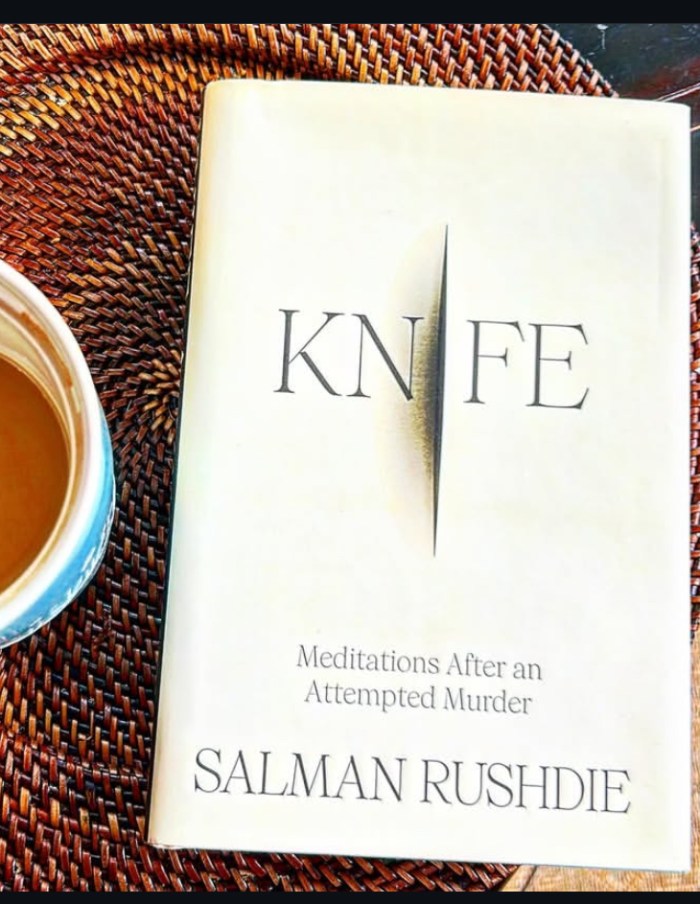
Last June my husband and I visited Oregon and we had to find a bookstore. I’m always available to pop in to a local indie and so we ventured forth into Sunriver Books. I have read or own many of the books on the literary fiction shelves. The collection was well curated but modest in quantity. My husband suggested we wander the non-fiction shelves and I told him you pick for me. As a true crime fan, I expected he’d choose something with a murder in the title. Alternatively, he will pick something political that we both enjoy. The book pictured above, “Knife: Meditations After an Attempted Murder” is what he chose for me. In this issue of Bookisshh I’ll discuss this brief book about a life-changing event. Enjoy.
I haven’t read many books by Salman Rushdie. In fact, I’ve only read one. “Haroun and the Sea of Stories” seemed written for children. It also appeared suitable for people struggling with fear and loss. In essence if my memory serves me correctly, a father is taking his son into stories of the sea, to learn lessons on life of courage, bravery and survival. The book was written for one of Rushdie’s sons who resides in Europe while Rushdie lives in the United States. In the story the boy (IRL his son) was afraid of travel transportation—planes, boats etc.— which were necessary for him to make his journey from Europe to the states with or to see his father. This intense fear is tempered by the fatwa placed on Salman Rushdie’s life in 1989. That fatwa was pledged because of the book, “The Satanic Verses“. It triggered many religious extremists against the author. For years, Rushdie required security wherever he traveled or lived and his son never fully recovered from his travel anxieties which becomes a necessary challenge in 2022 when his father is attacked by a martyr at a freedom of speech writers conference.
Salman Rushdie is an advocate for freedom of speech. Rushdie was intricately involved in the Penn Faulkner foundation which protects writers publishers and readers from freedom of speech violation. The author has won several awards and has published many novels, articles and essays. He is a literary elder statesman and survived a heinous attack on his life very recently during 2022. Courageously Rushdie survives being stabbed 15 times all over his entire body.
Back to the origin story of this purchase since I am working my way through an autoimmune disease which some days brings me extreme challenges,, my husband thought it would be good for me to see how someone overcame a difficult time. He thought I can find some inspiration. What I’ve been through the past year is not nearly as serious as the tragedy which Rushdie endured, but it has been life-changing for me, and so I read in hopes to find strength or inspiration

The author uses the word meditations, and I think it is entirely appropriate for the way this book is written. It’s about eight chapters and just over 200 pages in total length. Each chapter states the history of the event during which he was stabbed at a writer conference 15 times (including in his eye) and how his body and mind became separate as a result during his recovery process. Rushdie spends time taking readers through his wounds and the medical attempts of managing and healing them. It was highly visceral writing and at times grotesque. Although not mentioning his injuries at all would detract from the humanity one needs to activate when receiving his story. It’s hard to read and thankfully brief.
Inspiration came to me in learning how Rushdie rearranges his thinking in order to process what happened to him and how his life would change as result. He did not allow himself to be trapped in regression or victimization. The author/survivor knows when to lift up those rocks so to speak to see what’s underneath them as he lays a new path for life forward. Rushdie does all the things: he cooperates, persists, remains focused, loves wholeheartedly the people who remain close to his life, and practices gratitude for life itself. That was inspiring and in retrospect helpful.
A writing technique Rushdie employs in this memoir, whichI particularly enjoy are the crafted dialogues between Rushdie and his assassin. Using imaginary inner dialogues Rushdie works through his varied and intense feelings toward the person who tried to kill him. By witnessing anBy witnessing a conversation that hasn’t take place the author removes possible guilt for not extending forgiveness to his would-be assassin, nor does the author indulge in rage and anger. Rushdie does however tell his assassin what he thinks about him and demonstrates the lessons that the assassin would not be able to escape during his time in prison. Through these inner dialogues Rushdie makes a plan for how he will live his remaining days and not live them as the would-be assassin‘s victim. I don’t want to tell you everything the book says and does but what I will tell you is that he carries on and has a good head about it. From this book I wouldn’t call what I gained strength or inspiration. I am glad to know however that resilience can be accessed at any age for any reason and for this I’m glad to have read this book.
Coming out the other side of this book. I’m not entirely sure. I’ll read others by Rushdie— he cites too many thinkers and authors from the very distant past, and I’m not sure I’m passionate enough about his work to read his heroes and contemporary in order to understand Rushdie better. There are simply too many books and two little time to achieve this kind of understanding. For someone who might wish to dive deep on Salman Rushdie I will be sending this book onward to the local used bookstore for someone else to read and appreciate the risks that writers take to promote freedom of speech and the value of one human life for the sake of the many. Peace.
 Bookisshh