

In this issue of Bookisshh, we take a look at the novel, We Love You Bunny, by Mona Awad. Readers will journey to an ivy-esque campus and anuthor, Awad interrogates a cultish MFA writing program. This work portrays the lengths Ivy leaguers will go to exert esoteric upon academia. There’s a lot of wealth and racial privilege seated in the seminars on campus. We Love You Bunny centers the story around a group of female graduate students who are insecure about their writing when confronted by their seminar leader named Allen whose feedback enrages the coeds. When challenged regarding their writing, the Bunny coeds become hysterical and form a Bunny cult that will stop at nothing to regain their confidence. Bunny, Awad’s earlier book to know all that, but Awad recaps her prior book in We Love You Bunny—albeit the author states can be read as a stand alone novel. A problem with writing a prequel/sequel is that it’s hard to keep the story line and the characters, their conflicts and moves. This is why I did engage with Awad’s prior companion book Bunny. More on this later..
When the story begins the Bunnies have graduated from their MFA programs and are back on campus for an event and to confront a former classmate, Samantha, on how she represented them in her best selling novel. The Bunnie’s have crafted a revenge scheme to take out on on a lone wolf, non-Bunny classmate Samatha. The Bunnies take the lone wolf Samantha hostage due to a violent story that featured each and every one of the Bunnies. Here’s where the pages really stack up. Awad restores justice for her offended characters in Bunny by letting each and every one of the bunnies retell the same story from her own point of view. Exhausting… I actually have PTSD from We Love You Bunny and cannot remember the ending. The scenes just keep reverberating which makes me concluded that the adaptation of this book will most likely be internalized misogynistic horror—campy of course… You’ll have to read We Love You Bunny to discover the ending. No spoilers here but definitely a precautionary warning for toxic female friendship and hysteria PTSD 😉.
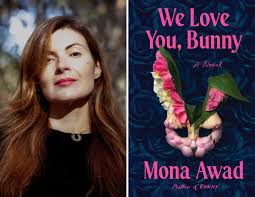
There are things to be enjoyed when reading works crafted by Mona Awad who used to be an auto-read for me. Awad writing masterfully employs magical realism in just the right amounts. She also interrogates issues affecting the lives and minds of women like how patriarchal systems constrain women’s lives and the toxicity patriarchs produce. Awad’s vibrant and luminous writing collages, layers, and live-activates. It incorporates smell-o-vision, butchery, and is a wee bit witchy. It also includes installation art, fashion, and fantastic playlists. Awad’s work explores fairytales, poetry, Shakespeare, and Jungian and Freudian psychologies. Awad draws from classical literature, waves of feminism, and beauty myths. The narratives consider both the female and male gaze alongside body horror. This is just the shortlist.
In We Love You Bunny, Awad utilizes her creative tools extensively. On every page you will be sensorially assaulted and overstimulated as you and the lone wolf Samantha are speechless and held captive. It’s as if Awad has spent a month roaming around an inspiration shopping mall. Image the author throwing EVERY on-sale trend item into her freebie tote. Then she tosses all her spoils into a commercial grade mixer along with her laptop and her original book, Bunny. After this, Awad recites incantations mixed with Shakespeare, Ginsberg, and music from the 80s and 90s. Next she pours these glop of toxic Bunnies, unpublished manuscripts, tacky romantic kinky fashion and other nostalgic detritus into a layered sheet cake mold shaped like a book. After baking for 6 years, out pops the prequel/sequel, We love You Bunny. It took 6 years to bring this book back from its afterlife. The book achieves two things. It brings back sales for her earlier book. It also burdens the reader with time/opportunity decision-loop considerations. Smart and selfish don’t you think? Furthermore why go to all this trouble anyway? Read further to see.
The Bunny novels have a cultish fanbase. If you follow Bunny affiliated hashtags on social media, you’re submerged into a vibrant world. In this world, women are on the edge of fashion and kink. The lace is dark. The heels are skyscraper high. There are all shades of pink and purple. The vibes express, “You can look but do not touch.” Many posts feature dark-haired women. They wear vintage or conceptual clothing. These women incorporate a bunny mask or ears. For the prissier Martha Stewart types, there are bookclub or holiday pajama parties. These events feature pink bowed rabbit sugar cookies in cellophane gift bags. Afternoon tea styled miniature sandwiches and pastries are served. Champagne in flutes and a gaggle of girls with fresh blowouts. They wear white faux silk pajamas from Amazon. They’re having fun as they do the version of feminism they’ve extracted from these novels. For the dark warrior, punky, Scottish culty bunnies, many posts were staged in forestry or dramatic interiors. These girls wear various plaid and mini skirts. They also wear ripped tights and layered torn edgy T-shirts. They have on dark polish and severe makeup. Dark bunny masks or ears finish their look. These bunnies have a “F around and find out” attitude. No matter which bunny you align with as a cult member, you use the hashtag: we love you bunny. The author, Mona Awad, put a lot of effort into liking and commenting on her fans Instagram feeds. Nonetheless, when the campaign launched at the end of summer to early fall for this book, Instagram was flooded. Some beautifully creepy merchandise flooded the marketplace. Then it went silent.
As earlier mentioned, 6 long years passed between Bunny and We Love You Bunny. That’s a long lapse in time to remember plot and character. What remained mostly for me were vibes. There was internalized misogyny between female characters. I observed a Frankenstein-esque transformation of men who are composited with rabbits. Additionally, there was commentary about Ivy League MFA writing programs. I didn’t have time to re-read Bunny. I wanted to fully enjoy We Love You Bunny (a whopping 479 pages) and stay on my editorial calendar. So I listened to the audiobook for Bunny. The narrator was too cutesy. It reminded me of Heathers or Scream Queens. Both of Mona Awad’s Bunny books are compared to a mashup between Frankenstein and Heathers. I don’t disagree and yes it’s this AND more. If you’ve watched American Horror Story then you’ve probably watched Scream Queens. Both series are directed by Ryan Murphy, a king of satire and campy horror. We Love You Bunny should be directed by Murphy. It is campy and satirical.
The richness of sensory details contained within We Love You Bunny is what kept me reading to the last page. Her is visceral and entirely immersive. Also, the settings were film-like and theatrical. It will be interesting when the production company, Bad Robot Productions adapts Bunny. I am excited to see the jewel-toned moods, the range of fashion and costumes, and rich architectural settings. I’m curious for the portrayal of magic and gore imposed upon the poor bunnies at Warren College. The potential for good music crossing into several eras holds great promise for this Awad adaptation. However, a sore spot for me is harmful practices on animals I don’t like to see them experimented upon, exploded or buried. It rubs me the wrong way, even when used for comedic purposes.
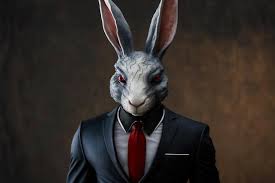
A key reason I read to the last page is because Awad does something much different in this book than in her other works. She explores male characters in greater degrees. Awad is hard on men. In fact, the only male with positive male influence and presence in We Love You Bunny is Shakespeare. Shakespearean themes and words pepper the novel throughout. To this end Shakespeare’s states of torment read as romantic, lush, and beautiful. But Shakespeare is not a character in this book and Aerius is. Aerius is created by all of the Bunnies who during a fit of female hysteria much seen in the Salem witch stories when women hysterically emote and incant. In this case Aerius is willed forth into existence outside near a rabbit Warren during a full moon evening. You should note that Aerius is part rabbit, part dandy, and part red haired pirate. What goes into Aerius are ideal male qualities desired by each of the Bunnies as well as each a conglomeration of shadow selves, belonging to each Bunny cult member. Aerius is also the only character who the Bunnies seek physical affection from. Aerius has deep knowledge of all of the female characters and their psychic wounds, and is thus considered perfect because he understands each and every one of them. Aerius also becomes an obsessive project of revision for all of the women who seek to inform and improve him and they imprison him until he escapes. This is why Aerius is in a constant state of confusion or crisis—there is no ideal male for whom all women will fit perfectly with.
Here is where the book becomes distracting to read. The dialogue of Aerius suffers strange syntax, and emoji symbols. The reader becomes too aware of the text changes and is removed from the actual story a gain Aerius’ story blows up but he has no narrative privilege in examining the past as the Bunny narrators do. Aerius becomes an escapee and can only find true love with a male character. As he escapes the Bunnies during Halloween night, he goes off on a killing spree. Aerius kills who he thinks are aliens which is an unconscious mission imposed on him by the Bunnies. If you are confused and think this is too much, imagine how I felt while I was actually reading We Love You Bunny to its full conclusion that even at this writing I cannot recollect…
What I do recall is that when I got to the end of the book, I felt exhausted. It was as if I had traveled through a cognitive renaissance or bipolar episode neither of which were my own. It seemed as if I endured a time warp that was hard to reconcile. It’s the “Mona Awad effect” because her books challenge many important narratives. Before you can understand what she’s interrogating you go on a wild ride. The world that Awad lures you into becomes more weird and more wild. It feels claustrophobic and oppressive. It’s a whole lot. I was glad when I reached the last page. I won’t ever reread the Bunny books. Still, I do appreciate the impetus Awad fosters for her readers to contemplate things that plague the lives of women. I just wish she did a little less. I just wish she didn’t write a prequel/sequel. Sometimes a writer has to move on and apply their craft to a whole new story. When that time comes, I’m not gonna lie, I’ll probably read Awad’s next tale as long as it’s not a Bunny book. We’re just not sure Bunny 🐇…
 Bookisshh