
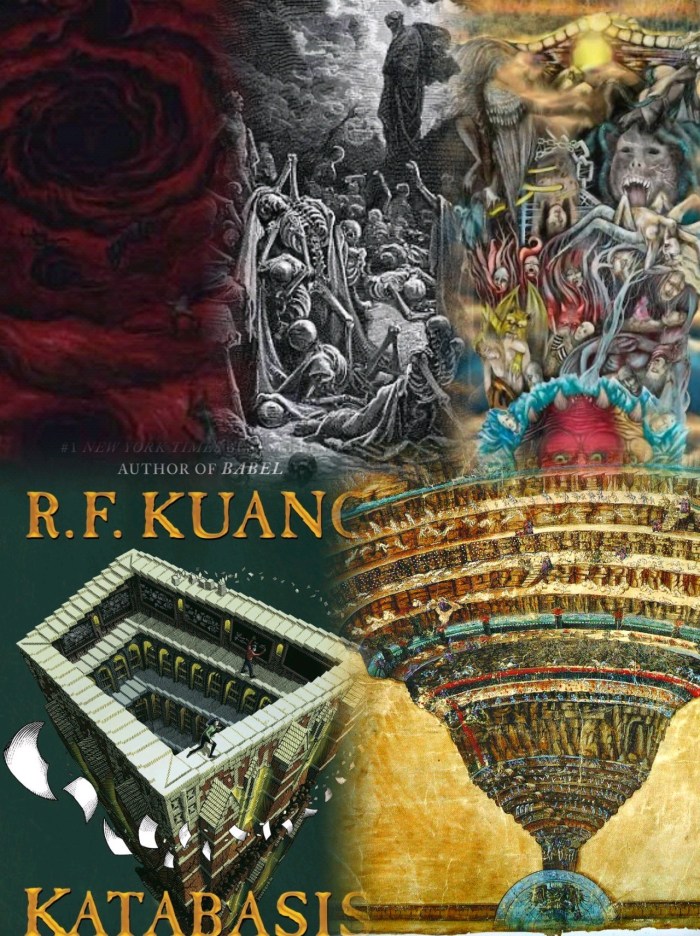
There are so many ways to go to Hell. For some a journey to hell involves being naked and afraid on a reality show that takes place on a remote island. For others a journey to Hell involves working professionally in any of the 3 branches of the United States government. For R.F. Kuang going to Hell involves a life that involves being a professional student grinding out time in prestigious institutions in this case Cambridge, England. Welcome to Katabasis which in Ancient Greek mythology defines as “a descent into the underworld.” How does all this come to play? Kuang dramatizes a protagonist on the verge of her PhD completion who regretfully murders her advisor who has not yet signed off on her final dissertation. Hence this character can’t graduate nor secure a position within the upper echelons of academia. In this issue of Bookisshh we’ll go to Hell with Kuang and her cast of nerdy, quirky and occasionally evil geniuses. Be prepared to puzzle through a matrix of philosophical, mythological and arithmetic quandaries in Kuang’s Hell as well as characters and creatures who won’t ever leave this final frontier..
A journey to Hell regardless of the hellscape design is best not taken alone and so Kuang sends Alice Law and Peter Murdoch, Cambridge graduate students who study analytic magick. Alice and Peter are colleagues and both maintain high IQs in everything one needs to be successful except emotional and physical intimacy. These two naive geniuses simply can’t read cues or express intimate authentic feelings toward one another which cheats this story of the romantic tension that can make the heart really beat with feeling. The connection between these characters is complex; relations are filtered via flashes of past futile efforts at romance. Instead of mature emotional communication Kuang throws disparate fragments of academic expertise within Analytic Magick back and forth between Alice and Peter. Even the academic competitiveness does not build drama as it dulls the sparks that ignite an emotional purpose for this treacherous tale. What keeps these characters motivated and moving is a common end goal—go to Hell, grab your professor, get him to sign your dissertation and get back alive. Sounds easy maybe but in Kuang’s underworld the only way to navigate is by integrating Dante, Orpheus and Eurydice, Karma, Aristotle, and MC Escher’s theories and constructions as they encounter facades, unimaginable creatures, entities, illusions and tests.
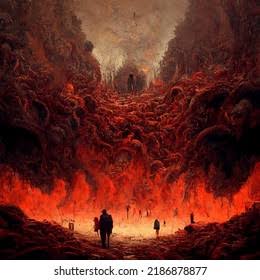
So what’s Kuang’s Hell like? Kuang lures her characters and readers into a hellscape that includes bloodbaths, raging fires, catacombs lined with bones, rivers polluted with disintegrating human bodies, their consciousness and memories, as well as structures with never ending spaces and disappearing exits. Zombie animals out for blood roam the landscape and are always in attack mode. Shadows and shades of formerly alive souls pass through you mindlessly on a mission either to discover why they’re exiled to Hell or how they can leave. It’s rare for anyone to leave Hell if they entered as dead people but Alice and Peter have a shot at leaving if they move cautiously and with clear intention. For those of you who don’t bat an eye at gore, you’ll be fine if your brain can hold together, build and sustain Kuang’s world disrupted by all the random bits of esoterica she tucks between the paragraphs and pages of which there are many…Unfortunately, as a cat lover I am horrified by the animal cruelty that is performed on cats and to a lesser extent dogs. Take care if you’re disturbed which as a cat lover I continue to be..
It might interest you to know that Kuang is also a collector of degrees and Katabasis reads like an off-loading of all the information she has processed over the course of her own graduate studies. Between writing a trilogy, two stand-alone novels, winning a host of prestigious literary awards, Kuang has achieved: an MPhil in Chinese Studies from Cambridge; an MSc in Contemporary Chinese Studies from Oxford; and is now pursuing a PhD in East Asian Languages and Literature at Yale. Kuang centers this last round of studies around diaspora, contemporary Sinophobia literature, and Asian American literature. She is brilliant and has developed a deep knowledge base grounded in linguistics and storytelling. Out of sincere respect, I feel like Kuang’s brain is packed to the max with academic information and sharp creativity but she punishes storytelling with her information overload because she needs to off load…
Both Katabasis and Yellowface (her previous novel) suffer from simmering hostility. While it’s a writer’s prerogative to craft any tale, voice and examine truths, and dramatize lived experience, it may not land how the writer intends. In this case the content and plot left this reader frustrated and fatigued. In Yellowface readers are positioned as witness or micro aggressor to a failed white female writer’s theft and publication of a story written by a murdered female friend and Chinese American author. It was an intense story of cultural co-opting. I cared about and registered the obvious and necessary hostility in Yellowface. In this case hostility is a reasonable effect to induce in readers. However, the hostile current running through Katabasis does not make sense. I’m a pretty curious person but I experienced hostility while reading because too frequently I had to disrupt my reading and research Euclidean Geometry or Greek Mythology in order to visualize the shifting settings and re-contextualizing characters and stories hailing from Ancient Greek mythology. Is this novel a syllabus for understanding WHAT Katabasis really is? Or is this novel 460+ pages of notes for a novel titled Katabasis? I much prefer a fluid reading process over a fragmented, disruptive, barrage of events.
Rather then wandering an abyss with characters externally focused I prefer gaining access to a character’s deeper emotional spaces and furthermore their catharsis (an emotional release). Kuang shutters this opportunity too often over her 460+ pages and leaves both her characters and readers overstimulated, exhausted, and emotionally empty. Alice and Peter are emotionally shallow and inexperienced and this flattens these characters who barely have a story arc. There are revelations both painful and/or humiliating that Alice and Peter have endured and they are dismissed or unexamined as quickly as they are disclosed to readers. Kuang’s characters are zombie-like over achievers who are burnt out from long hours in labs. Alice and Peter have spent years of youth coursing through the academic meat grinder only to miss the joys of good food, strong friendship, deep love, puddles of tears and unbounded laughter. They’ve traded their youth for mastery and control over the theoretical and abstract —in this case it’s Analytic Magick.
I am hopeful for Kuang and her characters both present and in the future. In Katabasis Kuang acknowledges a value for friendship, love, and committed relationships. Alice and Peter do discover a way out of Hell and readers witness the wisdom offered by the most powerful Chinese deity in multicultural Hell and nature, beauty and physical pleasure win in R.F. Kuang’s Katabasis. Not a coming of age, not an individuation from family, culture, or community either. Katabasis reads like an unfulfilled journey that yielded a character’s claim of personal artifacts jumbling around in their backpack with scarred scraps of academic detritus that perhaps will never be examined, celebrated, or discarded.
 Bookisshh